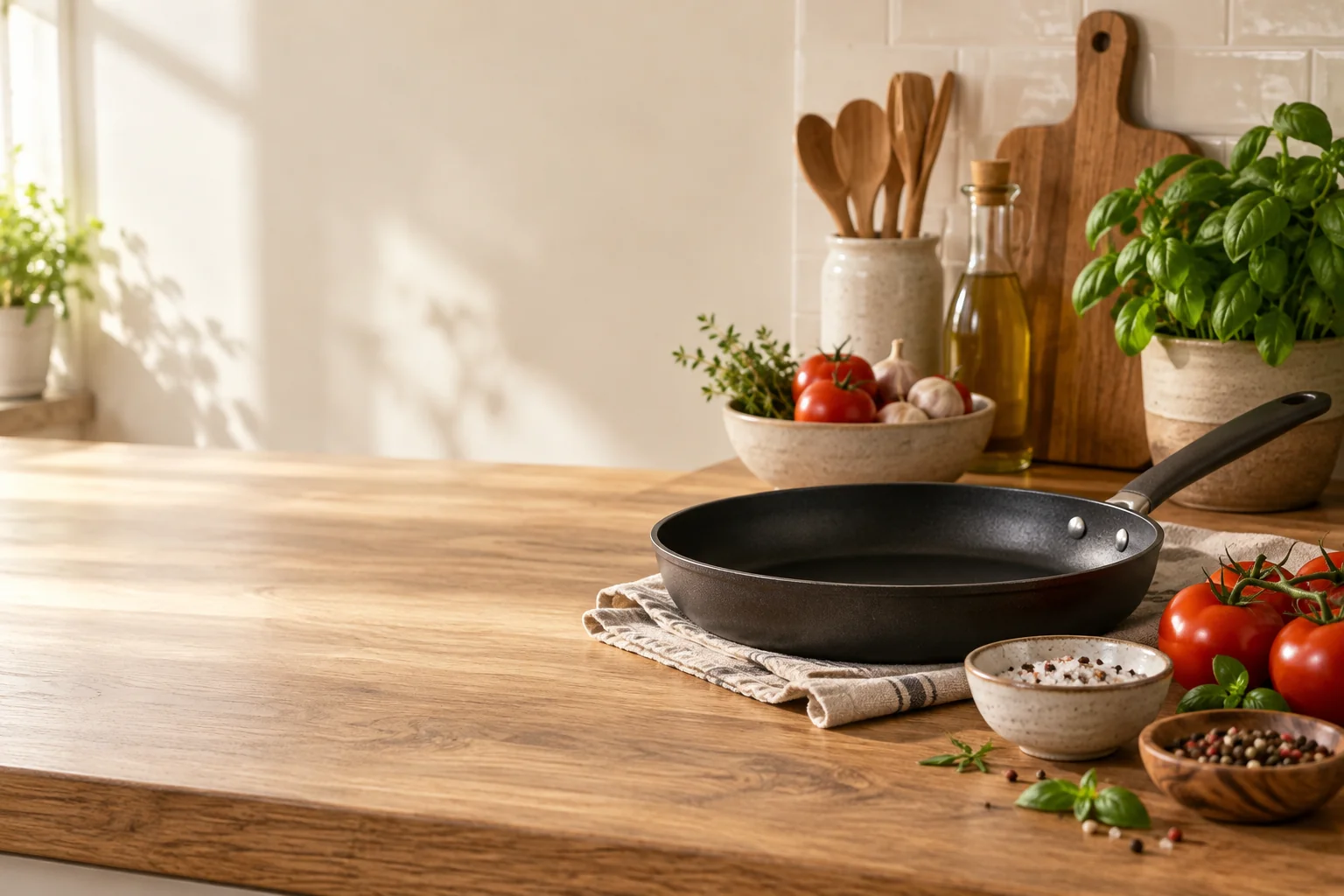
The kitchen and household department covers everything that is used daily, and a frying pan is probably the most used pan of all. The right one depends on what you cook, which hob you have and how much care you are willing to give it. This guide covers the materials, the diameter, the base, the coating and the lid, so that the choice fits real cooking rather than a set of marketing terms.
Match the pan to your hob
Check the hob first. Gas and electric ceramic hobs work with almost any pan. Induction hobs only heat pans with a magnetic base, so a pan must be labelled induction compatible, usually with a coil symbol. Plain aluminium does not work on induction unless the base includes a steel or ferromagnetic disc. If you might change hob in the future, an induction-ready pan is the safer choice.
The base should be flat and reasonably thick. A thin base warps when it is heated, which leaves the pan rocking on the hob and creates hot spots. Bases that are 3 mm and thicker generally spread heat better, although a thick base also makes the pan heavier.
Materials and what they are good at
- Cast aluminium or forged aluminium with non-stick coating: light, heats quickly, good for eggs, pancakes and delicate fish with little oil. The coating is the limiting factor in lifespan.
- Cast iron: very heavy, slow to heat, holds heat superbly. Suited to searing meat and baking in the oven. It needs seasoning, hand washing and drying to avoid rust, unless it is enamel coated.
- Carbon steel: lighter than cast iron, heats faster, also seasoned. Popular for high-heat frying and woks.
- Stainless steel: durable and dishwasher-friendly, tolerates metal utensils. Food sticks without enough fat and heat control, so it takes practice. A multi-layer base with an aluminium or copper core improves evenness.
- Ceramic-coated: a mineral-based non-stick surface without PTFE. Slippery at first, but the effect often declines faster than that of a good PTFE coating.
Non-stick coatings
Most non-stick pans use PTFE-based layers. Multi-layer or reinforced coatings, sometimes with stone or titanium particles in the description, are more resistant to scratching than a single thin layer. All coatings suffer from overheating, metal utensils, abrasive sponges and dishwashers, even where the label says the pan can go into one. Use wood, silicone or nylon tools and heat to medium rather than maximum. Stop using the pan if the coating flakes. Manufacturer instructions state the maximum temperature, which is commonly about 250 C.
If you want a pan that lasts decades, steel or iron is the answer. If you want easy eggs and pancakes with minimal fat, a coated pan is practical and should be treated as a consumable.
Diameter and depth
Diameter is normally measured across the top, not the cooking surface, which is smaller. Typical guidance:
- 18 to 20 cm: a single egg, a small portion, toasting spices, sauces.
- 24 cm: one to two people, general use.
- 26 to 28 cm: a family of three or four, chicken pieces or a large omelette.
- 30 cm: large batches, but it may not fit smaller burners and can be hard to heat evenly.
Match the pan to the burner. A burner much smaller than the pan leaves the edges cold, while a flame that rises up the sides of the pan wastes gas. Depth matters too: low, flared sides suit flipping and tossing, higher straight sides suit sauces and shallow frying.
Pancake pans
A pancake pan has a very low rim, a flat, wide surface and often a lighter body. Diameter of 22 to 28 cm suits ordinary pancakes, with thinner crepes made on a pan of 24 to 30 cm. A light pan is easy to swirl so the batter spreads thinly. Non-stick coating is the common choice, since pancakes can tear when they stick.
Lids and handles
A lid helps when you simmer, steam or finish food gently. Glass lids let you watch without lifting them, but check whether a lid is included and whether it matches the diameter exactly. Universal lids in steel or glass cover several sizes; a tight fit matters less than a fit that sits stably. Handles should stay cool on the hob. Bakelite, silicone-coated and hollow steel handles are common. If you want to use the pan in the oven, check that the handle and lid are rated for it and what temperature is stated.
Pre-purchase checklist
- Confirm compatibility with your hob, especially induction.
- Pick the material that fits how you cook and how you wash up.
- Choose the diameter by number of portions and burner size.
- Check the base thickness and the weight you are comfortable lifting with one hand.
- Look for a stated oven temperature and utensil guidance.
- Check whether the lid is included and what it is made of.
- Read the care instructions before buying, particularly regarding dishwashers.
 Furniture and interiorHow to Choose an Armchair
 Perfume and cosmeticsHow to Choose a Women's Perfume
 ToysHow to Choose a Board Game
 ComputersHow to Choose a Computer Mouse
 Diy and toolsHow to Choose a Cordless Drill Driver
 Clothing shoes and accessoriesHow to Choose a Men's T-Shirt or Polo Shirt
 Health and beautyHow to Choose a Home Blood Pressure Monitor
 Tv audio and videoHow to Choose a TV: OLED, QLED, Size and Specs Explained
 Food and drinkHow to Choose Coffee Beans and Capsules
 Home appliancesHow to Choose an Automatic or Capsule Coffee Machine
 Sport and outdoorsHow to Choose a Treadmill or Walking Pad
 GardenHow to Choose a Lawn Mower: Petrol or Electric, Push or Self-Propelled
 Plumbing heating and climateHow to Choose a Tower, Desk or Handheld Fan
 Kids and babyHow to Choose a Pushchair or Travel System: Weight, Fold, Seat
 Car and motorbikeHow to Choose a Dash Cam: Resolution, GPS, Wi-Fi, ADAS, Rear
 Pet suppliesHow to Choose Dog Toys: Chew, Rope, Ball and Plush Toys Compared
 Gifts decorations and flowersHow to Choose a Mug as a Gift: Novelty, Porcelain, Self-Stirring
 BooksHow to Choose Manga and Fiction Editions: Omnibus and Deluxe