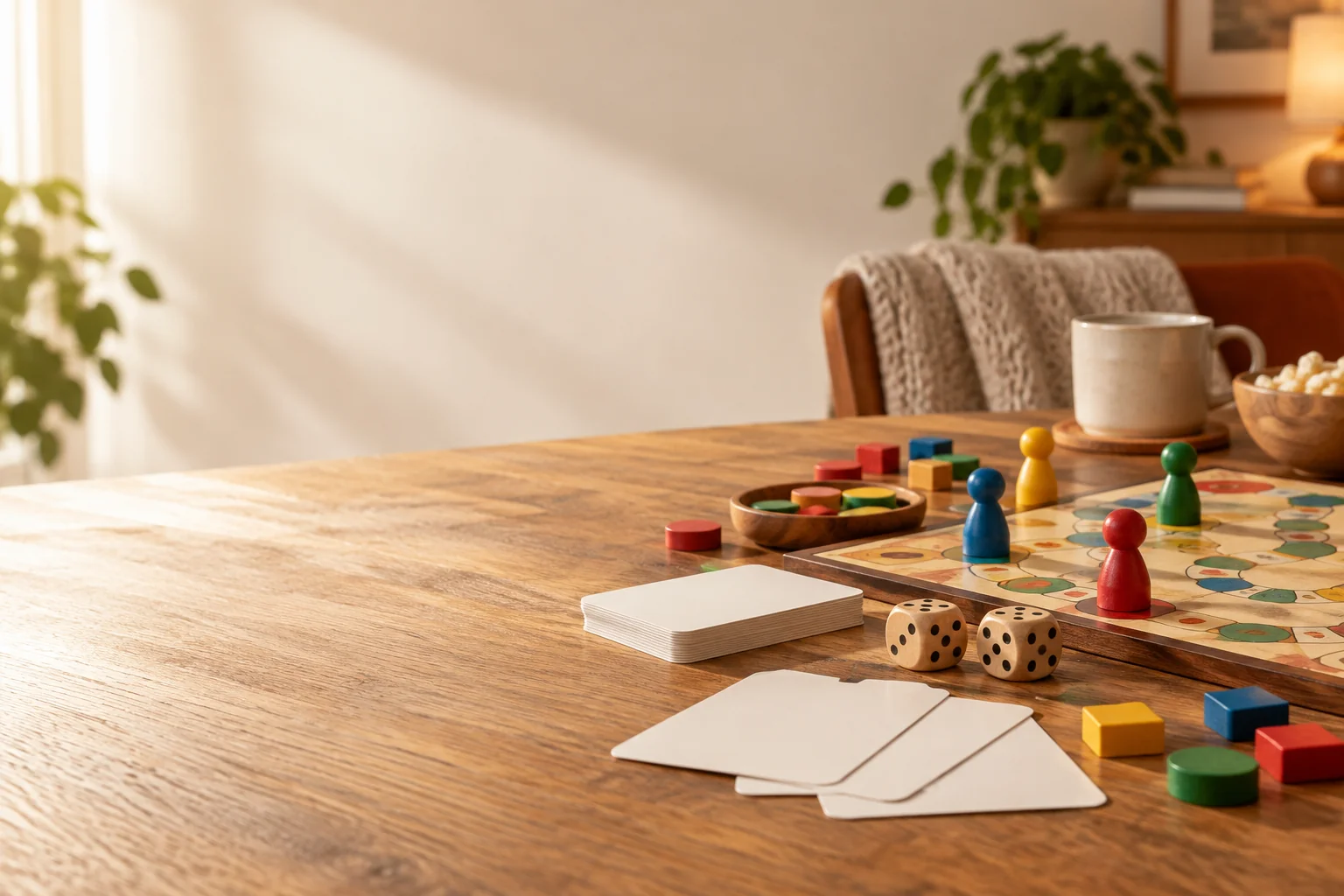
In the toys department, board games and puzzles differ from most other products because the product is really an evening spent with other people. A game that suits the group is played for years, while one that does not suit it stays in the box. This guide explains how to read the information on the box, how to match a game to the people who will play it, and what to check in classic games such as chess, trading games and card games.
Start with who is playing
Think about the group before the game. The key questions are how many people there will usually be, how old the youngest and oldest players are, and whether they enjoy competing, cooperating or building something together.
- Player count: the box shows a range, for example 2 to 4. Some games work only at the top or bottom of the range, so check reviews or rules for the count you will actually use. Two-player games are a separate group and often work better for couples or a parent and child.
- Age rating: a number such as 8+ is a guide to rule complexity and sometimes to small parts, not a quality mark. Younger children can often manage a game rated slightly above their age with help.
- Playing time: the printed time is generally for an experienced group. Allow longer for the first game, as learning the rules may add 15 to 30 minutes.
Complexity and learning the rules
Games range from a few lines of rules to a thick rulebook. A rough way to classify them:
- Family or gateway games: rules explained in about 10 minutes, a game of 30 to 60 minutes. Suitable for mixed ages and occasional players.
- Mid-weight strategy games: more options and planning, 60 to 120 minutes. Suitable for groups that already play regularly.
- Heavy strategy games: long rulebooks, many components and two hours or more per game.
A useful test is whether one person is willing to read the rules and teach the others. If nobody will, choose a simpler game. Many publishers offer a video tutorial or a rules summary on their site, and watching one before buying removes much of the uncertainty.
Types of games
Knowing the main types helps to avoid buying something that does not fit.
- Resource and trading games: players collect resources, build and trade. Negotiation is part of the fun, and the game includes some luck from dice or cards, which keeps it open to beginners.
- Property and economic games: classic roll-and-move games where luck is large and the game can last long. They are well known and easy to teach, but a game can run past the patience of younger players unless you agree on a shortened rule set.
- Abstract strategy: chess, draughts and similar games have no luck at all. The result depends on skill alone, which is satisfying for matched players and discouraging when skill differs greatly.
- Card games: compact, cheap to carry and quick to teach. Some use ordinary playing cards, others a special deck with its own rules.
- Cooperative games: everyone wins or loses together against the game. A good option for families who dislike conflict.
- Puzzles: the piece count sets the difficulty and the time: 500 pieces is a sensible start for adults, 1,000 takes several evenings.
Details for classic games
For a chess set, check the board size and the size of the pieces. A king around 8 to 10 cm tall is comfortable for regular play, and squares of about 5 cm suit the pieces. Weighted pieces stay steady, and a folding board with storage is convenient. Tournament-style boards use squares of 5 to 6 cm.
A chess clock is for timed games. Digital clocks are more versatile because they can handle increments and several time controls, whereas analogue clocks are simpler. Check that it has a pause button and that the display is easy to read from across the table.
For card games, look at the language of the cards and whether the game needs a certain number of players, since some work poorly with two.
Quality and components
Good components make a difference over many plays. Check for sturdy cardboard tokens, a board that lies flat, cards with a stiff finish and dice that roll evenly. Cards that get handled a lot may benefit from protective sleeves. Make sure the edition matches the language you want: some games have text on the cards and others are language-independent. Expansions are separate products that require the base game.
Pre-purchase checklist
- How many people will normally play, and what are their ages?
- Is the printed playing time realistic for the first game?
- Who will learn and teach the rules?
- Does the group prefer luck, strategy or cooperation?
- Is the game in the right language, and does it need expansions?
- Is there enough table space for the board and components?
- For chess, are the board and pieces sized for comfortable play?
 Furniture and interiorHow to Choose an Armchair
 Perfume and cosmeticsHow to Choose a Women's Perfume
 Kitchen and householdHow to Choose a Frying Pan
 ComputersHow to Choose a Computer Mouse
 Diy and toolsHow to Choose a Cordless Drill Driver
 Clothing shoes and accessoriesHow to Choose a Men's T-Shirt or Polo Shirt
 Health and beautyHow to Choose a Home Blood Pressure Monitor
 Tv audio and videoHow to Choose a TV: OLED, QLED, Size and Specs Explained
 Food and drinkHow to Choose Coffee Beans and Capsules
 Home appliancesHow to Choose an Automatic or Capsule Coffee Machine
 Sport and outdoorsHow to Choose a Treadmill or Walking Pad
 GardenHow to Choose a Lawn Mower: Petrol or Electric, Push or Self-Propelled
 Plumbing heating and climateHow to Choose a Tower, Desk or Handheld Fan
 Kids and babyHow to Choose a Pushchair or Travel System: Weight, Fold, Seat
 Car and motorbikeHow to Choose a Dash Cam: Resolution, GPS, Wi-Fi, ADAS, Rear
 Pet suppliesHow to Choose Dog Toys: Chew, Rope, Ball and Plush Toys Compared
 Gifts decorations and flowersHow to Choose a Mug as a Gift: Novelty, Porcelain, Self-Stirring
 BooksHow to Choose Manga and Fiction Editions: Omnibus and Deluxe